Audience Research: Adobe and Artificial Intelligence
- lilyfinley9
- Oct 8, 2024
- 4 min read

Updated: Oct 9, 2024

Background
When Generative Artificial Intelligence crashed into daily life seemingly overnight, many of the world's largest companies moved fast to get their foot into the new market. Among these companies vying for their position in the AI scene was Adobe, Inc. — a tech company known for pioneering creative softwares like Photoshop and Premiere Pro.
When Adobe adopted generative A.I. tools in its creative software, it sent shockwaves throughout the online creative community. Unluckily, these shockwaves were not in Adobe's favor.
Illustrators, photographers, videographers and other creative professionals who rely on Adobe's creative softwares for their livelihoods were suddenly swearing off Adobe products online, decrying the company's disrespect for their profession.
One Adobe user's viral reaction to a change Adobe made to its Creative Cloud privacy policy which was misconstrued to imply Adobe would use user-generated content to train its AI.
What should have been a revolutionary foray into a new technology for creatives turned into a major backlash for Adobe. Clearly, expectations were misaligned between the tech giant and its consumer base.
For my Public Relations Research class at the Walter Cronkite School of Journalism and Mass Communication, I chose Adobe as a client to conduct audience research on throughout the semester — hoping to understand where this misalignment occured and how it could be prevented in the future. My audience research project consisted of...
background research.
an audit of Adobe's online communications channels.
an audit of Adobe's mentions in traditional media.
an interview with an Adobe user.
a survey of more than 40 Adobe users.
bi-weekly monitoring of Adobe's primary Instagram account.
a final analysis and reccomendations.
Findings
Although small, my primary research into Adobe's consumer audience revealed a mismatch in ideas about artificial intelligence between the company and its userbase.
Of all findings from the research, one stood out as the most consistent across research methods: Consumers have strong ethical concerns about generative AI. This was especially true for the image-generating AI Adobe most often implements in its programs.
Survey participants overwhelmingly disagreed or strongly disagreed when faced with the statement "Art created by an A.I. should be considered 'real art.'" Expectedly, this reaction was most prominent for Adobe users who did not use generative AI at all within a month of taking the survey, with 80% of the group disagreeing and strongly disagreeing. More suprisingly, it remained consistent among participants who did regularly use AI in the month leading up to the survey, with the largest share — 45% — also disagreeing or strongly disagreeing with the statement.
The finding was also backed by interview data, in which the Adobe user interviewee said:
"Generative AI in pictures ... is kind of messed up... If you can just AI that image ... then that’s kinda gonna ruin it if you see it for real."
The same finding was made clear in the eight bi-weekly audits of Adobe's largest Instagram account, @adobe. While posts about the generative AI features in Creative Cloud made up some of the highest-engagement content Adobe posted during the tracking periods, they just as consistenly made up the posts with the most backlash in the comment sections.
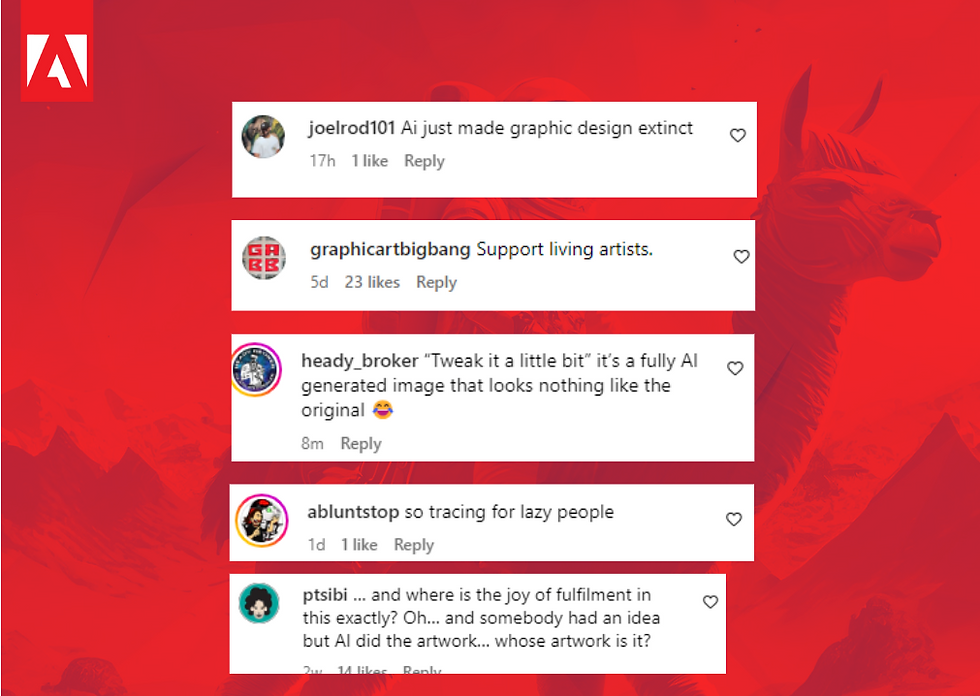
User backlash in the Instagram comment section of Adobe's largest Instagram account, @adobe, under a post showcasing generative AI tools in Adobe Creative Cloud.
However, despite these concerns, Adobe users are still adopting AI technology. Two-thirds of users surveyed said they used AI within a month of taking the survey. Of them, more than 90% estimated their usage at once per week or more and more than half agreed with the statement "Generative A.I. is useful in my daily life."
So, while the audience's concerns are a cause for frequent backlash, Adobe's new generative AI offerings are not far off the mark from meeting their needs. A simple adjustment in messaging may be enough to have the best of both worlds: minimizing concerns and backlash while maximizing an increasing demand for AI products.
Recommendations
To achieve a greater balance between Adobe's need to market a product with rapidly growing demand and a similarly rapid fear-based backlash from audiences, I developed two recommendations for further communications around generative AI:
Shift from framing AI-generated content as finished artwork in social media and other promotions.
Throughout my analyses of Adobe's promotions of generative AI online, I noticed a common trend — Adobe frequently frames Creative Cloud's generative AI tools as the lest step in an artists' process of creation. The result is a piece that, though technically includes human creativity, looks entirely AI generated.
Social media promotions for Adobe's "structure reference" generative AI tool begins with an artist's work, then uses generative AI to create a final product.
As Adobe's comments sections will prove, this framing is detrimental to their overall message. Regardless of the process, audiences react as if the piece is fully AI generated and thus replacing the creative's part in the process. By changing this framing to include AI as a first or even middle step a process that ends with an artist putting their unique spin on the AI generated material, audiences may be less likely to react negatively to the idea that they are being replaced.
Openly address audiences' concerns about the future of AI tehnology.
Data collected throughout the research process showed over and over again that audiences are concerned about how AI technology will develop in the future. Despite this, most tech companies are racing ahead in AI development in efforts to become the brand name in AI. This creates a prime opportunity for Adobe to get ahead by being the one to slow down.
While not necessarily slowing down in their technology development or product releases, Adobe can be one of the few tech brands tailoring its communications to cater to the concerns of creatives in a time of massive industry change. By better publicizing existing materials like the brand's commitment to AI ethics, Adobe can stand out to audiences while assuaging their fears about AI technology used unethically.
This case study is a brief synopsis of a more than 70-page research report about Adobe, Inc. and its communications tactics around generative AI. View the report to learn more about my research and its full findings: https://drive.google.com/file/d/1rhbAsl4FBXvxMnTjE4XKgZBGOUHRDRqe/view?usp=sharing
Comments